


The Best Brushing Boot?
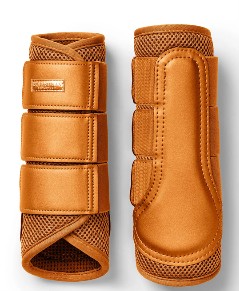
The Great Brushing Boot Illusion: Are We Protecting Our Horses, or Just Dressing Them Up?
All of us know what a brushing boot is. There are an endless array of matching, colourful, fleece and fluffy-lined brushing boots. As equestrians, we buy into the marketing completely. We are told that slapping a 5mm layer of neoprene or fluff around a horse’s lower leg is the ultimate shield against everyday knocks, scrapes, and catastrophic field or arena trauma.
But let’s pause the consumer wheel for a second and look at the actual physics of what happens when a horse takes a bad step. Are we actually mitigating injuries, or are brushing boots just glorified, high-priced leg warmers?
The Best Brushing Boot Matrix: What Options Do We Have?
If you still believe in the magic of a boot, you generally choose between three camps:
- The Neoprene Traditionalists: Think of classic, budget-friendly options like Shires and Le Mieux They are quick to put on and offer basic scuff defence.
- The Luxury Matchy-Matchy Crowd: Brands again like Le Mieux and Equestrian Stockholm focus on high aesthetics—sleek finishes, faux-fur trims, and matching saddle pads.
- The Technical High-Ventilation Innovators: Newer-gen options, such as Husk ditch neoprene entirely to combat heat retention using porous PVC and mesh layers.
But before you spend top dollar on any of them, it’s time for a harsh reality check.
The Physics of a Strike: The Numbers Don’t Lie
We use brushing boots to protect the fragile cannon and splint bones from being struck by the opposite hoof. Now, think about a heavy horse—or even a heavily built sport horse—moving at a trot or a canter.
Let’s look at the actual kinetic energy involved:
- A single lower leg and hoof of a large horse, complete with a heavy steel shoe, weighs roughly 5 to 8 kilograms (11 to 17 lbs).
- During a dynamic trot or canter swing phase, that leg travels forward at speeds easily reaching 8 meters per second (about 18 mph).
When you calculate the kinetic energy (\(KE = \frac{1}{2}mv^2\)), that single swinging leg generates roughly 256 Joules of energy.
To put that into context, that is equivalent to someone dropping a 26-kilogram (57 lb) concrete block directly onto your horse’s bare leg from a height of one meter.
When that massive force impacts the tiny, superficial splint bone, the pressure is highly localized. We are talking about thousands of Newtons of blunt-force trauma hitting a bone covered by a mere millimetre of skin.
Enter the “Glorified Leg Warmer”
Now look at your favourite pair of brushing boots. They are usually composed of a thin layer of foam or neoprene, perhaps backed by a flimsy piece of moulded plastic.
Do you honestly think 5mm of synthetic rubber is going to dissipate 256 Joules of kinetic energy?
Spoiler alert: It won’t. A brushing boot is highly effective at stopping a superficial skin graze or a mild hair scuff if a horse slightly brushes past itself. But against actual bone-shattering or bruise-inducing blunt force trauma? It offers almost zero structural shock absorption. The boot compresses instantly to zero thickness under that kind of load, transferring the entirety of the strike right into the periosteum of the bone.
The Hidden Danger: Cooking the Tendons
If the lack of real protection doesn’t make you think twice, the thermal data should. Peer-reviewed research, including studies published in the Journal of Equine Veterinary Science, consistently highlights that wrapping a horse’s leg acts as a powerful insulator.
During exercise, the superficial digital flexor tendon stretches and recoils like a spring, generating immense internal heat. Without a boot, the air cools the leg. With a boot on, the leg becomes a mini-sauna, frequently trapping temperatures above 40°C (104°F). At these temperatures, tendon cells have been proven in vitro to suffer degradation and core tissue damage.
The Verdict: Time to Re-evaluate
By putting brushing boots on for every routine flatwork session, we might be making a terrible trade-off. We are insulating the tendons and risking heat-induced cell death all to protect against a minor skin scuff, while fully deceiving ourselves into thinking the boot will save the leg from a true impact injury.
If your horse has standard, straight conformation and doesn’t actively interfere, the safest boot might just be no boot at all. Or choose a boot proven to have the best protection and airflow on the market – the Exoskeleton
What do you think? Are you ready to ditch the matchy-matchy sets, or does the peace of mind (even if it’s an illusion) keep you strapping them on?